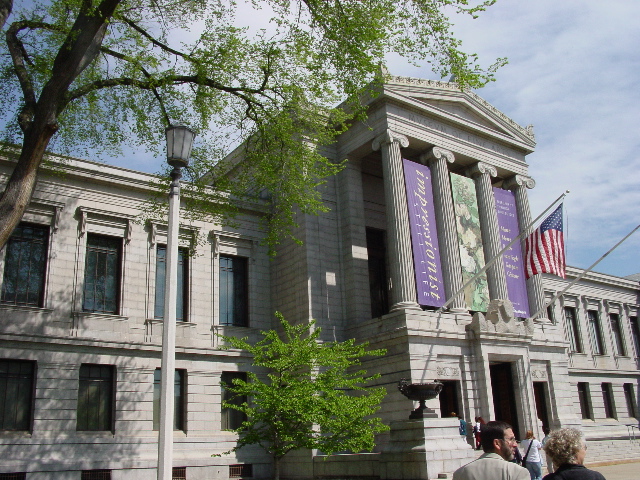
Museum of Fine Arts, Boston
Art museum in Boston, Massachusetts, United States.

Center for Computing & Data Sciences at Boston University
The Center for Computing & Data Sciences at Boston University is a defining landmark for the university. It transforms the skyline, meets laudable sustainability goals, and prioritizes human-centered design, maximizing collaboration and interconnectivity. The project brings together the mathematics, statistics, and computer science departments, building a community for some 3000 students, faculty, and staff. It maximizes opportunities for collaboration, interconnectivity, and innovation while bringing sustainability to the forefront. The exterior is characterized by a 19-storey cantilevered volume that rises 305 feet high and features eight green terraces to connect the Center to the natural environment. The podium extends to occupy much of Commonwealth Avenue, completing the streetscape and generating maximum ground floor animation on the street. Highly transparent and porous, it functions as an urban porch for arrival, study, and gathering. The Center is conceptualized to function as ascending academic neighborhoods with bottom floors devoted to math and statistics, middle floors for computer science and the top floors for interdisciplinary work and public space. A central atrium unites faculty and students in a collaborative spirit and an interconnected staircase emerges from the area weaving upwards eight floors to connect various disciplines, nurture cross-pollination of ideas and spark serendipitous encounters. Open interior spaces take advantage of the Center’s unique position in the heart of Boston, with unrivaled views afforded from three sides of the building. Classrooms and collaboration spaces are illuminated with an abundance of light through the triple-glazed curtain wall. Each floor is characterized by bright colours including red, green, purple, turquoise, and blue that are employed in a monochromatic fashion for furniture and surfaces to aid in wayfinding. Modular furniture systems allow for flexibility and adaptability, anticipating the needs of future faculties and student bodies while also infusing comfort for all. A central atrium on the main floor invites students from all studies into the building. What’s more, whiteboard walls throughout the core stimulate collaborative ideation while putting processes on display. The state-of-the-art building includes 12 classrooms, two computer labs, a cafe on the ground floor, numerous collaboration spaces and a plaza with a covered bicycle shelter. Natural light is optimized throughout all spaces in the building. The stacked campus culminates in an event space and pavilion at the top level that fosters collaborative engagement and offers unrivaled views of the city. The design sets an ambitious new sustainability precedent for future academic buildings in Boston and beyond. In line with Boston University’s Climate Action Plan, which aims to reduce the institution’s carbon emissions to zero by 2040, the Center is targeted to attain LEED Platinum, and is 100% fossil-fuel free with a geothermal closed-loop system that heats and cools the building through a ground source heat pump system. The building draws on renewable and alternative energy sources, including a ground water recharge system and cutting-edge exterior shading systems.
Center for Computing & Data Sciences, Boston University
Just as data sciences is the unifier, the new building is located and designed to mark a new hub for the Boston campus, and the dynamic change as a university for the 21st century. The design offers a vision for the building as an extension of the street, to activate and animate Commonwealth Avenue. It focuses on forging continuity and connectivity for the campus, presently divided by Commonwealth Avenue. It envisions Commonwealth Avenue as a seam that unifies both sides of the campus. It also integrates a network of laneways and landscaped courts at the street level to connect to the townhouses along the street. The corner of Commonwealth and Granby establishes a gateway to the Charles River and asserts the presence of the Computational Sciences as the new center of the campus. The tower is set back from the podium to mitigate its impact on the street and to align the height of the podium to buildings along Commonwealth. The base addresses the street and is transparent and porous to activate ground floor animation on Commonwealth Avenue. It has outdoor gathering spaces at both ends and acquires the street as an urban porch for study and gathering. Inside, the ground floor and upper level of the podium are expansively public, and contain a series of zones for interaction: the Café, the Cascading Stair, the Street Studio and the Fireplace Lounge. Vertical Campus As the University expands, the concept of the vertical campus addresses growth and intensification, effectively organizing the departments of the Computational Sciences Building into academic neighborhoods within the podium and tower. A central atrium with a spiraling, interconnecting stair intensify opportunities for exchange and spontaneous interaction while providing visual connectivity to all levels of the Podium. The tower is organized as a series of stacked floorplates with outdoor terraces. The transparent envelope maximizes views of the campus, city and river and the form provides a distinct profile on the city skyline from all directions, and especially from across the river.
Center for Engineering, Innovation, and Sciences
Center for Engineering, Innovation & Sciences Sense of Place The Wentworth Institute of Technology campus is imbedded in the heart of Boston’s Back Bay community surrounded by neighborhoods and peer institutions. The relationship between town and gown is critical to the Institute’s mission and sense of place. Many students live in the neighborhoods and the Institute values maintaining a constructive dialogue and relationship with the Mission Hill neighborhood. This is the first new building for the Institute in 40 years and its design became a chance to strengthen the relationship with the surrounding neighborhood, formalize the campus quad and convey the forward thinking image of the Institute. The new Center for Engineering, Innovation and Sciences, a flexible, multi-disciplinary lab, classroom and professorial office building, sought to convey openness beyond the student population and welcome the neighborhood. The highly glazed first floor displays its interior activity to pedestrians on Parker Street. The flexible lobby, which can become a presentation space, gallery, lecture hall and casual gathering space has become the heart of the Institute. Sense of Campus The Wentworth campus is a collection of light colored buildings brick buildings of the post war years and concrete buildings of the 60’s and 70’s. The new building placement was an opportunity to create a quad to become the heart and core of the campus. It was designed to fit in to the scale of its surroundings while this modern building with its metal clad façade sits in harmony with its context. Due to the high Back Bay water table, the campus buildings tend to have raised basements and high piano nobile first floors, well above the pedestrian eye level. Walking by the small windows and rusticated bases of the campus conveys a closed unwelcoming environment. This building sought the opposite by making a universally accessible and visually open first floor that displays to pedestrians and passing cars the activity inside. Pedagogic Mission Wentworth is a technical school of hands on learning and close student/faculty relationships. The upper floors have flexible labs with glass walls from the corridor and faculty offices off of informal common spaces, inviting interaction. The first floor is a maker floor, with a multi-purpose lobby, a 3D maker space facing the public street and Accelerate, an entrepreneurial manufacturing facility where students gather to design and create ideas and products. The community runs weekend programs in these spaces, empowering neighborhood teens by creating a bridge between high school and higher education. Resiliency Intended to be a visible demonstration of sustainable design, the Center incorporates enhanced metering for the Institute’s use and student demonstration. The project exceeds the City of Boston’s requirements of sustainability with a highly-efficient thermal envelope, including sun shading on the east, south and west facades, and mechanical equipment designed for maximum efficiency including low-flow fume hoods. Raising the ground floor two feet above current grade and minimizing systems equipment in the basement are resiliency measures that have already proven themselves to be wise decisions.
The Floating Bridge
PRELUDE A bridge connects one place to another. It is also “a time, place, or means of connection or transition” (Merriam-Webster). Some bridges derive distinctive meanings from their unique locations, technologies, and histories. These include the Northern Avenue Bridge, engineered by MIT students and built in 1908 to link Boston proper with the Seaport District across Fort Point Channel. As a technological tour de force, it became the signature gateway to and from Seaport. CONCEPT Our proposal transforms the bridge into a ship that docks at diverse Boston Harbor shores. Becoming an iconic landmark on each waterfront, island or wharf it moors at, it activates local cultural and educational events and recreational activities there. Throughout the year it changes shores, thereby connecting disparate communities and places in a “hands across the sea” gesture, bringing people together from all around Boston and surrounding communities. BRIDGE AS ENERGY GENERATOR Two of the bridge’s three bays will have glass roof canopies with embedded PV cells (BIPV). Tidal turbines will be placed in the channels between the pontoons, creating more renewable energy, to be stored in large battery arrays in waterproofed bays on the pontoons. The bridge can thus sustain its own energy needs, depending on its energy demands. BRIDGE AS LIVING HISTORY The Northern Avenue Bridge will retain its historical significance while adding a new chapter to its rich history: it becomes part of both new and traditional civic rituals and takes the form of a new signature element in the city’s civic and maritime iconography. BRIDGE AS MULTI-USE PROGRAM PLATFORM The three bays can be programmed for concerts, fairs, festivals, parties, weddings and other community events. They can also be platforms for educational and research programs on marine science, climate change, etc., for students. Support vehicles (food carts, educational trailers, restrooms, etc.) can be wheeled onto the bridge as events demand. BRIDGE AS DOCK The bridge can also become a mid-harbor floating dock. Its pontoons allow boats from around New England to berth there so visitors can disembark onto the bridge. A TYPOLOGICAL TRANSFORMATION The Northern Avenue Bridge remains a bridge to Seaport, but it can readily be sent afloat. It sits on six perpendicular pontoons with small motors coordinated to power and navigates its motion. A structural web of steel supports elevates it, creating a habitable space between the bridge’s underside and pontoons. WHAT HAPPENS TO FORT POINT CHANNEL WHEN THE FLOATING BRIDGE IS ON CRUISE? For three seasons, the bridge’s main structure will be on cruise, leaving a gap in the span across Fort Point Channel. This void will be filled by two of the bridge’s landside segments to reestablish its pedestrian connection between Boston Proper and the Seaport (see diagrams). Assisted by two concealed cranes on the relocated granite bulwark foundations, the shorter and otherwise stationary bridge segments are swiveled into position on pontoons to create a new pedestrian crossing. This is made possible because the current concrete-granite circular-base pivot will be removed. During the three seasons where the bridge is floating out in the harbor, the four segments of the bridge will be strung together, and the two temporary central sections will float and bob with the tides as they rise and fall. When it’s winter home-port, the bridge is reconnected to the four stationary sections. If boats need to traverse Fort Point Channel, the bridge can be maneuvered out of the way, powered by its pontoon engines. DESTINATIONS – PORTS OF CALL While the Floating Bridge would remain in its “home port” on Fort Point Channel in the winter, the remaining three seasons offer it rich options for ports of call for weeks or months at a time. The choice of these locations is informed as much by their historical significance. 1. Fort Point Channel - Winter 2.Charlestown Navy Yard - Spring: The bridge will be positioned on the USS Constitution’s wharf. 3. Long Wharf: - Summer: The bridge would temporarily extending State Street deeper into the harbor, as a symbol of the history of Boston’s most significant street-wharf extension. New England Aquarium and North End festival events could be coordinated with this location. 4. Boston Harbor (July 4th) - Summer: Anchored strategically (and safely) in a central location in Boston’s Harbor, the Floating Bridge serves as a dock and harbor-based platform for cultural and festive activities. 5. Spectacle Island - Summer: With the city as a dramatic backdrop, the approach and anchoring of the bridge to the island’s wharf give an already remarkable destination to another visual dimension. 6. East Boston Piers Park - Fall: The bridge is anchored to Piers Park, offering East Boston residents a remarkable setting for recreational, cultural and educational events.
Center for Computing & Data Sciences
The Center for Computing & Data Sciences at Boston University is a landmark for the university. It transforms the skyline, meets laudable sustainability goals, and prioritizes human-centered design, maximizing collaboration and interconnectivity. The project brings together the mathematics, statistics, and computer science departments, building community amongst the 3000 students, faculty, and staff. Realized as a vertical campus. Towering boldly over the banks of the Charles River at 19 storeys, and spanning 345,000-square-feet, the Center is the largest, sustainable, operational fossil fuel-free building in Boston. Recognized by its cantilevered volumes that feature both reddish-brown-coloured diagonal louvered (to minimize solar gain and maximize shading) and gleaming mirrored sawtooth facades that rest atop the triple-glazed curtain wall that clads the structure. While contributing to the building’s distinctive linear aesthetic, these design elements also contribute to comfort and sustainability efforts, keeping the building warmer in the winter and cooler in the summer. The podium hovers over Commonwealth Avenue to complete the streetscape and generate maximum ground floor animation on the avenue. Highly transparent and porous, it functions as an urban porch for arrival, study, and gathering. The Center is conceptualized to function as ascending academic neighborhoods with lower floors devoted to math and statistics, middle floors for computer science and the top floors for interdisciplinary work and public space. A central atrium unites faculty and students in a collaborative spirit and an interconnected staircase emerges from the area weaving upwards 138 floors to connect various disciplines, nurture cross-pollination of ideas and spark serendipitous encounters. The design sets an ambitious new sustainability precedent for future academic buildings in Boston and beyond. In line with Boston University’s Climate Action Plan, which aims to reduce the institution’s carbon emissions to zero by 2040, the Center is targeted to attain LEED Platinum, and is 100% operational fossil-fuel free with a geothermal closed-loop system that heats and cools the building through a ground source heat pump system. The building draws on renewable and alternative energy sources, including ground water recharge system and cutting-edge exterior shading systems. Open interior spaces take advantage of the Center’s unique position in the heart of Boston, with expansive river views afforded from three sides of the building. Classrooms and collaboration spaces are illuminated with an abundance of light with floor to ceiling windows to remind students enveloped in the digital realm to remain inspired by the natural world and remember the link between technology and humanity. Whiteboard walls throughout the core stimulate collaborative ideation while putting processes on display. The state-of-the-art building includes 12 classrooms, two computer labs, a cafe on the ground floor, numerous collaboration spaces and a plaza with a covered bike shelter. The stacked campus culminates in an event space and three-storey-high open-air pavilion. Green roofs and terraces are located throughout the Center to connect students, faculty, and staff to the natural environment, and offer views of the city. These open spaces allow for increased connection and collaboration amongst the various departments that now call the Center home.

Leonard P. Zakim Bunker Hill Memorial Bridge
Cable-stayed bridge in Boston, Massachusetts.
Get optimized routing, transit times, and turn-by-turn directions.
Open in Atlas MapFrequently Asked Questions
How long does the Boston architecture walking tour take?+
The self-guided walking tour covers approximately 6.6 km with 3 stops. Allow approximately 2 hours including 20 minutes of viewing time per building.
Is the Boston architecture tour free?+
Yes, this is a completely free self-guided walking tour. You can view the route on the interactive map, export it to Google Maps for navigation, and explore at your own pace.
Do I need to book the Boston architecture tour in advance?+
No booking is required — this is a self-guided tour that you can start at any time. All buildings can be viewed from the outside. For guided tours with expert commentary, we recommend checking GetYourGuide for local architecture tours.
What is the best time to do the Boston architecture walking tour?+
Morning light (before 11am) is ideal for photography of building facades. Weekdays tend to be less crowded around commercial buildings. Allow a full morning or afternoon for the complete tour.